Buy mis1943.eu ?
We are moving the project
mis1943.eu .
Are you interested in purchasing the domain
mis1943.eu ?
domain@kv-gmbh.de · 0541-91531010
Buy mis1943.eu ?
What is the principle of leadership in history?
The principle of leadership in history is the idea that effective leaders possess certain qualities and traits that enable them to guide and inspire others towards a common goal. Throughout history, successful leaders have demonstrated characteristics such as vision, courage, integrity, and the ability to communicate effectively. They have also shown a willingness to take risks, make difficult decisions, and adapt to changing circumstances. Ultimately, the principle of leadership in history emphasizes the importance of inspiring and motivating others to achieve greatness. **
What is the economic principle: the principle of minimum or the principle of maximum?
The principle of minimum and the principle of maximum are economic principles that relate to decision-making. The principle of minimum states that individuals or firms will seek to minimize their costs or inputs in order to achieve a certain level of output or outcome. On the other hand, the principle of maximum states that individuals or firms will seek to maximize their benefits or outputs given a certain level of inputs or costs. Both principles are important in guiding economic decision-making and resource allocation. **

Similar search terms for Principle
Top-Angebote
Products related to Principle:
-
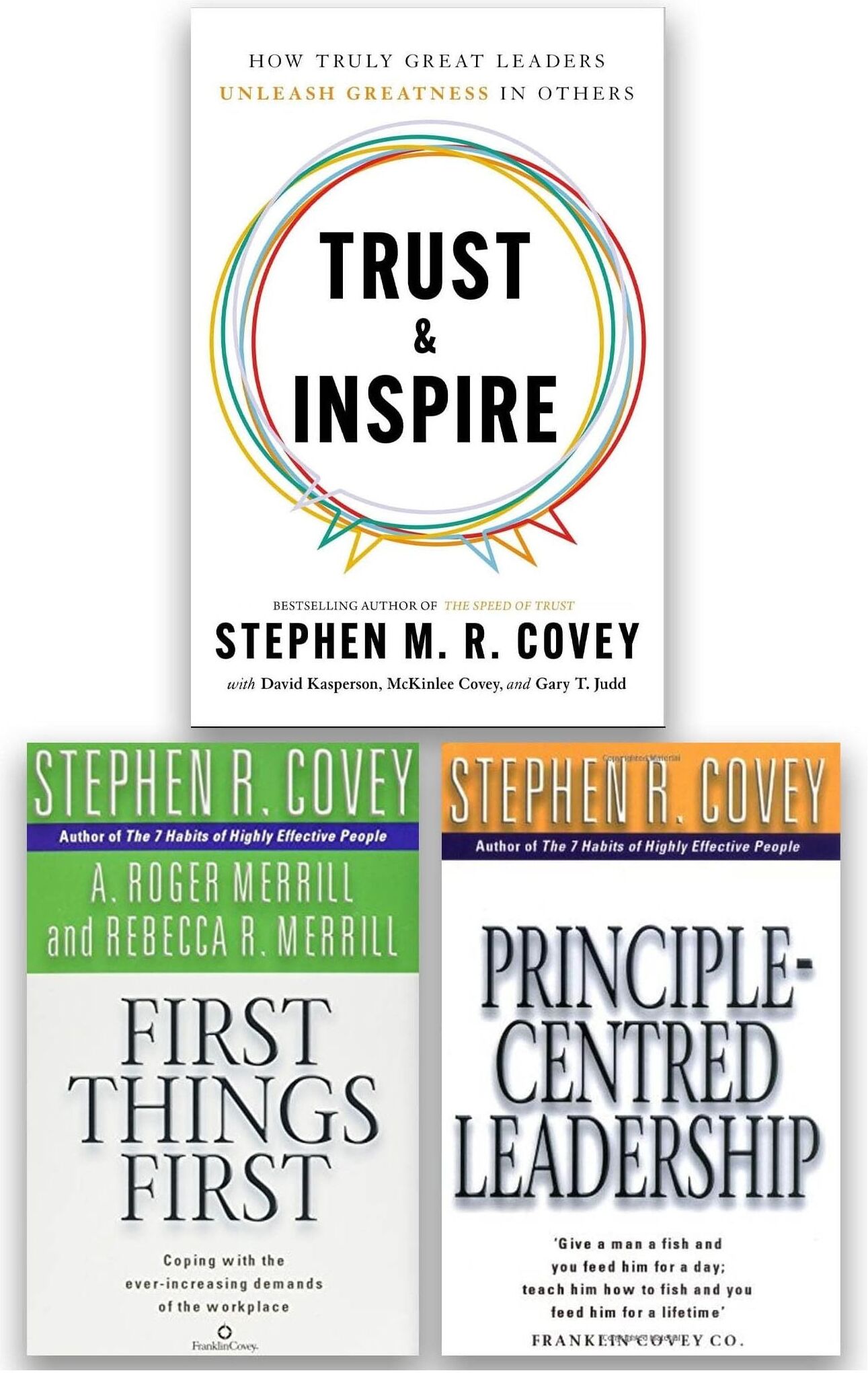
Simon & Schuster Stephen M. R. Covey 3 Books Collection Set (Trust and Inspire, First Things First and Principle Centered Leadership)Trust & Inspire Traditionally, businesses have relied on a“command and control” management style, focusing on rigid hierarchies andcompliance from employees. Covey argues we must shift from a “command andcontrol” to a “trust and inspire” leadership model. Trusting and inspiring yourteam is defined by commitment from both sides, with a focus on effectivenessand fostering a growth mindset. It is based on the belief that employees arecreative, collaborative, and full of potential; through trust, you can inspirethem to do their best work. First Things First I'm getting more done in less time, but where arethe rich relationships, the inner peace, the balance, the confidence that I'mdoing what matters most and doing it well? Does this nagging question haunt you, even whenyou feel you are being your most efficient? If so, First Things First can helpyou understand why we so often prioritize things that are unimportant to bothour larger goals and our inner happiness. Principle Centered Leadership PRINCIPLE CENTRED LEADERSHIP will help solve thesedilemmas - and many others:* how do we achieve a wise and renewing balancebetween work and family in the midst of constant pressures and crises?* how dowe unleash the creativity, talent and energy of the vast majority of the workforce, whose jobs neither require nor reward such resources?* how can we have aculture characterised by change, flexibility and continuous improvement andstill maintain a sense of stability and security?* how do we create team spiritand harmony among people and departments that have been criticising and attackingeach other for years?* how do we get people and culture aligned with strategy,so that everyone in an organisation is as committed to the strategy as thosewho formulated it?19,99 £*Shipping: 2,99 £Secure redirect to the provider
-
Gretsch Synchromatic 200 Sunburst c.1940s Vintage Archtop Acoustic Guitar Vintage Sunburst - RefurbishedThis is an incredible Gretsch Synchromatic 200 in Sunburst finish. This model was introduced by the original incarnation of Gretsch in 1939. The company was founded in Brooklyn, New York in 1883 by Friedrich Gretsch, initially as a drum manufacturer. The Synchromatic 200 was introduced in 1939 and discontinued by 1946. The serial number of this instrument is 3 digits handwritten on the inside of the body, indicating that it was made before Gretsch changed their serial number system in 1945/6. The Synchromatic 200 is an archtop acoustic guitar which features a set-neck construction comprising a Spruce top, Maple back and sides, Maple neck and 20 fret Rosewood fingerboard inlaid with Abalone blocks. The body is double-bound, with cateye soundholes, 'stairstep' Rosewood bridge, gold 'Harp' tailpiece & gold open-geared tuning machines. This particular instrument has been fitted with an Artec MHPA95-GD Mini Humbucker, which is wired directly to a 3.5mm output jack mounted discreetly under the pickguard. The Maple neck plays very well, with a profile which can be described as Asymmetrical; considerably shallower on the treble side and deeper on the bass side. This is certainly a unique playing experience when compared with modern guitars, and provides the Synchromatic 200 with a sense of exclusivity, which along with the playwear that the neck has developed over the years is very inspiring in the hands. The Rosewood of the fingerboard is pleasant under the fingers, with a 10" radius that is practical for a wide range of playing styles and techniques. The large Abalone block inlays add a touch of luxury, reminding the player of Gretsch's golden age. The acoustic voice of the Synchromatic 200 is distinctly archtop, with a dark and mellow tone that is perfect for jazz playing. Thanks to the large stature of the body and the twin large soundholes, the instrument projects very well and produces plenty of volume. The addition of the Artec MHPA95-GD Mini Humbucker adds the versatility required for live and recording situations, and despite its lack of on-board control produces a rich, mellow tone which is highly usable in a wide range of musical contexts. This is a beautifully preserved example of Gretsch's early work, which remains beautifully practical and playable today.3230,00 £*Shipping: 0,00 £Secure redirect to the provider
-
Nicholas Brealey Publishing The 80/20 Principle, Atomic Habits, How to Talk to Anyone Collection 3 Books Set by Richard Koch, James Clear, Leil LowndesThe 80/20 Principle The unspoken corollary to the 80/20 principle is that little of what you spend your time on actually counts. But by concentrating on those things that do, you can unlock the enormous potential of the magic 20 percent. Discover how to identify the few methods that will lead to great results, and use them alone. Avoid hard work. Don't push water uphill. Be very selective in what you do. Have a great life. Atomic Habits People think that when you want to change your life, you need to think big. But world-renowned habits expert James Clear has discovered another way. He knows that real change comes from the compound effect of hundreds of small decisions: doing two push-ups a day, waking up five minutes early, or holding a single short phone call. He calls them atomic habits. In this ground-breaking book, Clears reveals exactly how these minuscule changes can grow into such life-altering outcomes. How to Talk to Anyone Never be at a loss for words again! Perfect your people skills with his fun, witty and informative guide, containing 92 little tricks to create big success in personal and business relationships. In How To Talk To Anyone, bestselling relationships author and internationally renowned life coach Leil Lowndes reveals the secrets and psychology behind successful communication16,50 £*Shipping: 2,99 £Secure redirect to the provider
-
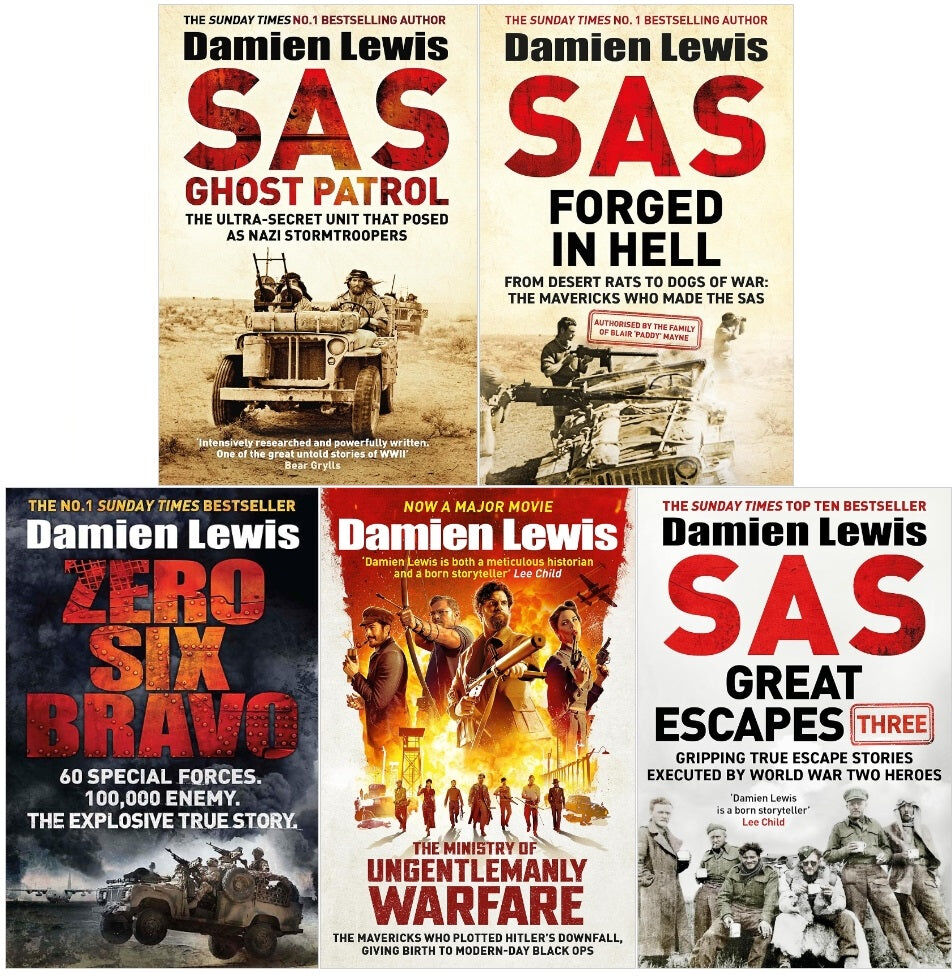
Quercus Damien Lewis 5 Books Collection Set – SAS Great Escapes & Military History CollectionThe Ministry of Ungentlemanly Warfare In the bleak moments after defeat on mainland Europe in winter 1939, wartime leader Winston Churchill knew that Britain had to strike back hard. He recruited a band of eccentric free-thinking warriors to become the first 'deniable' secret operatives behind enemy lines, offering these volunteers nothing but the potential for glory and all-but-certain death. SAS Great Escapes Three SAS Great Escapes Three recounts how warriors of the world's most famous fighting force, the SAS, carried out five of the most daring escapes of World War Two. Ranging from the very birth of the SAS, to the post D-Day battles for Nazi-occupied Europe, these gripping true stories cover some of the most iconic operations of the regiment, and its key characters, while also including untold tales of courage and endurance beyond compare. SAS Forged in Hell The incredible true story of the SAS's mission to liberate Europe, featuring never-before-seen archive materialFROM BESTSELLING MILITARY HISTORIAN DAMIEN LEWISSummer, 1943: the largest invasion fleet ever assembled sailed for Europe, aiming to bulldoze its way onto Nazi shores. At its vanguard went a few hundred elite soldiers, their Royal Navy warship bearing the iconic motto 'Who Dares Wins'. The aim: Led by the legendary SAS commander Blair 'Paddy' Mayne, these war-bitten, piratical raiders were tasked to do the impossible - to bulldoze their way onto the most heavily defended Nazi shores - against all odds, outnumbered fifty-to-one. SAS Ghost Patrol SAS Ghost Patrol is the explosive true story of the day in 1942 when the SAS donned Nazi uniforms to perpetrate the most audacious and daring mission of the war. Beyond top secret, deniable in the extreme (and of course enjoying Churchill's enthusiastic blessing), this is one of the most remarkable stories of wartime lawlessness, eccentricity and raw courage in the face of impossible odds - a thoroughly British undertaking. Zero Six Bravo The Sunday Times No.1 bestseller. 'Sixty special forces against 100,000 - a feat of British arms to take the breath away' Frederick Forsyth. They were branded as cowards and accused of being the British Special Forces Squadron that ran away from the Iraqis. But nothing could be further from the truth. Ten years on, the story of these sixty men can finally be told. In March 2003 M Squadron - an SBS unit with SAS embeds - was sent 1,000 kilometres behind enemy lines on a true mission impossible, to take the surrender of the 100,000-strong Iraqi Army 5th Corps.15,89 £*Shipping: 2,99 £Secure redirect to the provider


-
What is the principle of the key-lock principle?
The key-lock principle is based on the idea that certain molecules or structures (keys) can fit into specific receptors or binding sites (locks) with high specificity and affinity. This principle is commonly used to describe the interaction between enzymes and their substrates, where the enzyme (lock) has a specific active site that perfectly fits the substrate (key), allowing for efficient catalysis. The key-lock principle highlights the importance of complementary shapes and chemical properties between molecules for effective interactions to occur. **
-
What is the ping-pong principle or the hourglass principle?
The ping-pong principle, also known as the hourglass principle, is a communication strategy where information is exchanged back and forth between two parties in a structured and concise manner. It involves each party taking turns to speak or provide input, similar to a game of ping-pong. This principle ensures that communication is balanced, effective, and allows for active listening and engagement from both parties. It helps to maintain a focused and productive conversation by preventing one party from dominating the discussion. **
-
What is the rocket principle and the principle of recoil?
The rocket principle states that for every action, there is an equal and opposite reaction. This means that when a rocket expels gas out of its engines, the force of the gas pushing out is matched by an equal force pushing the rocket in the opposite direction. The principle of recoil is similar, stating that when a gun is fired, the force of the bullet being expelled from the barrel is matched by an equal force pushing the gun in the opposite direction. Both principles are based on Newton's third law of motion, which describes the relationship between the forces acting on two interacting objects. **
-
Does the principle of solidarity correspond to the principle of equivalence?
The principle of solidarity and the principle of equivalence are related but not the same. The principle of solidarity emphasizes mutual support and collective responsibility within a community, while the principle of equivalence focuses on equal treatment and fairness. Solidarity often involves individuals or groups providing assistance or resources to those in need, even if they have not contributed equally, whereas equivalence typically requires treating individuals or groups in the same way based on certain criteria. Both principles aim to promote fairness and justice, but they operate in slightly different ways. **

What are the principle of operation and the principle of object?
The principle of operation refers to the fundamental method or process by which something functions or operates. It outlines the underlying rules or guidelines that govern how a system or device works. On the other hand, the principle of object pertains to the main focus or purpose of a particular entity or concept. It defines the central idea or goal that the object is designed to achieve or represent. Both principles are essential in understanding the functionality and significance of a system or object. **
What is the principle of maximization or the principle of minimization?
The principle of maximization or minimization is a decision-making principle that involves choosing the best option from a set of alternatives in order to maximize benefits or minimize costs. In economics, this principle is often applied to the behavior of individuals, firms, or governments when making choices about resource allocation, production, consumption, or investment. The principle of maximization suggests that decision-makers seek to maximize their utility, profits, or other desirable outcomes, while the principle of minimization suggests that decision-makers seek to minimize their costs, risks, or other undesirable outcomes. These principles are fundamental to understanding how economic agents make rational choices in pursuit of their goals. **
Top-Angebote
Products related to Principle:
-
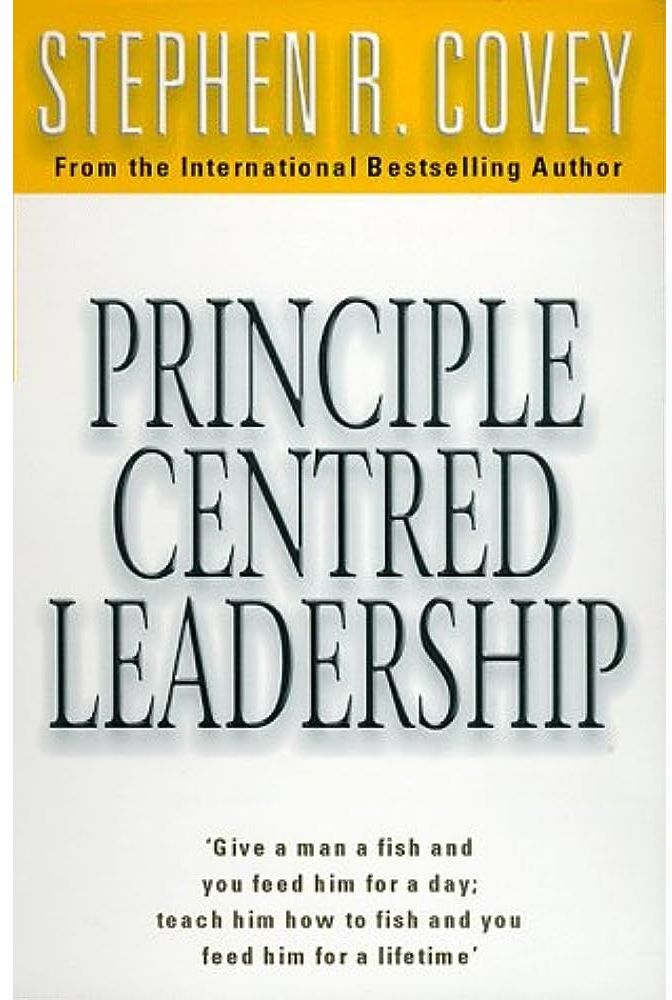
Simon & Schuster Principle Centred Leadership by Stephen R CoveyPRINCIPLE CENTRED LEADERSHIP will help solve these dilemmas - and many others:* how do we achieve a wise and renewing balance between work and family in the midst of constant pressures and crises?* how do we unleash the creativity, talent and energy of the vast majority of the work force, whose jobs neither require nor reward such resources?* how can we have a culture characterised by change, flexibility and continuous improvement and still maintain a sense of stability and security?* how do we create team spirit and harmony among people and departments that have been criticising and attacking each other for years?* how do we get people and culture aligned with strategy, so that everyone in an organisation is as committed to the strategy as those who formulated it?6,99 £*Shipping: 2,99 £Secure redirect to the provider
-
John Murray The 80/20 Principle : The Secret of Achieving More with Less: by Richard KochREAD THIS BOOK AND USE IT - TIM FERRISS Twenty years after its first publication, The 80/20 Principle is a global bestseller read by millions of highly effective people around the world. Now, it is more powerful and essential than ever. In the past, the principle gave those who used it a serious advantage.In the future, it will be the essential tool for anyone who wants to succeed. And it is powerful. Based on the counter-intuitive but widespread fact that 80% of results flow from 20% of causes, The 80/20 Principle shows how you can achieve much more with much less effort, time and resources, simply by concentrating on the all-important 20%.This major new edition includes four brand new chapters showing how to: Use the rise of networks to your advantage Benefit from more acute 90/10 and 99/1 forms of the principle Tap into your subconscious to exert a super-potent and amazingly favourable influence on your life Enjoy greater success with 5 mega rules to live by5,95 £*Shipping: 2,99 £Secure redirect to the provider
-
Simon & Schuster Stephen M. R. Covey 3 Books Collection Set (Trust and Inspire, First Things First and Principle Centered Leadership)Trust & Inspire Traditionally, businesses have relied on a“command and control” management style, focusing on rigid hierarchies andcompliance from employees. Covey argues we must shift from a “command andcontrol” to a “trust and inspire” leadership model. Trusting and inspiring yourteam is defined by commitment from both sides, with a focus on effectivenessand fostering a growth mindset. It is based on the belief that employees arecreative, collaborative, and full of potential; through trust, you can inspirethem to do their best work. First Things First I'm getting more done in less time, but where arethe rich relationships, the inner peace, the balance, the confidence that I'mdoing what matters most and doing it well? Does this nagging question haunt you, even whenyou feel you are being your most efficient? If so, First Things First can helpyou understand why we so often prioritize things that are unimportant to bothour larger goals and our inner happiness. Principle Centered Leadership PRINCIPLE CENTRED LEADERSHIP will help solve thesedilemmas - and many others:* how do we achieve a wise and renewing balancebetween work and family in the midst of constant pressures and crises?* how dowe unleash the creativity, talent and energy of the vast majority of the workforce, whose jobs neither require nor reward such resources?* how can we have aculture characterised by change, flexibility and continuous improvement andstill maintain a sense of stability and security?* how do we create team spiritand harmony among people and departments that have been criticising and attackingeach other for years?* how do we get people and culture aligned with strategy,so that everyone in an organisation is as committed to the strategy as thosewho formulated it?19,99 £*Shipping: 2,99 £Secure redirect to the provider
-
Gretsch Synchromatic 200 Sunburst c.1940s Vintage Archtop Acoustic Guitar Vintage Sunburst - RefurbishedThis is an incredible Gretsch Synchromatic 200 in Sunburst finish. This model was introduced by the original incarnation of Gretsch in 1939. The company was founded in Brooklyn, New York in 1883 by Friedrich Gretsch, initially as a drum manufacturer. The Synchromatic 200 was introduced in 1939 and discontinued by 1946. The serial number of this instrument is 3 digits handwritten on the inside of the body, indicating that it was made before Gretsch changed their serial number system in 1945/6. The Synchromatic 200 is an archtop acoustic guitar which features a set-neck construction comprising a Spruce top, Maple back and sides, Maple neck and 20 fret Rosewood fingerboard inlaid with Abalone blocks. The body is double-bound, with cateye soundholes, 'stairstep' Rosewood bridge, gold 'Harp' tailpiece & gold open-geared tuning machines. This particular instrument has been fitted with an Artec MHPA95-GD Mini Humbucker, which is wired directly to a 3.5mm output jack mounted discreetly under the pickguard. The Maple neck plays very well, with a profile which can be described as Asymmetrical; considerably shallower on the treble side and deeper on the bass side. This is certainly a unique playing experience when compared with modern guitars, and provides the Synchromatic 200 with a sense of exclusivity, which along with the playwear that the neck has developed over the years is very inspiring in the hands. The Rosewood of the fingerboard is pleasant under the fingers, with a 10" radius that is practical for a wide range of playing styles and techniques. The large Abalone block inlays add a touch of luxury, reminding the player of Gretsch's golden age. The acoustic voice of the Synchromatic 200 is distinctly archtop, with a dark and mellow tone that is perfect for jazz playing. Thanks to the large stature of the body and the twin large soundholes, the instrument projects very well and produces plenty of volume. The addition of the Artec MHPA95-GD Mini Humbucker adds the versatility required for live and recording situations, and despite its lack of on-board control produces a rich, mellow tone which is highly usable in a wide range of musical contexts. This is a beautifully preserved example of Gretsch's early work, which remains beautifully practical and playable today.3230,00 £*Shipping: 0,00 £Secure redirect to the provider
-
What is the principle of leadership in history?
The principle of leadership in history is the idea that effective leaders possess certain qualities and traits that enable them to guide and inspire others towards a common goal. Throughout history, successful leaders have demonstrated characteristics such as vision, courage, integrity, and the ability to communicate effectively. They have also shown a willingness to take risks, make difficult decisions, and adapt to changing circumstances. Ultimately, the principle of leadership in history emphasizes the importance of inspiring and motivating others to achieve greatness. **
-
What is the economic principle: the principle of minimum or the principle of maximum?
The principle of minimum and the principle of maximum are economic principles that relate to decision-making. The principle of minimum states that individuals or firms will seek to minimize their costs or inputs in order to achieve a certain level of output or outcome. On the other hand, the principle of maximum states that individuals or firms will seek to maximize their benefits or outputs given a certain level of inputs or costs. Both principles are important in guiding economic decision-making and resource allocation. **
-
What is the principle of the key-lock principle?
The key-lock principle is based on the idea that certain molecules or structures (keys) can fit into specific receptors or binding sites (locks) with high specificity and affinity. This principle is commonly used to describe the interaction between enzymes and their substrates, where the enzyme (lock) has a specific active site that perfectly fits the substrate (key), allowing for efficient catalysis. The key-lock principle highlights the importance of complementary shapes and chemical properties between molecules for effective interactions to occur. **
-
What is the ping-pong principle or the hourglass principle?
The ping-pong principle, also known as the hourglass principle, is a communication strategy where information is exchanged back and forth between two parties in a structured and concise manner. It involves each party taking turns to speak or provide input, similar to a game of ping-pong. This principle ensures that communication is balanced, effective, and allows for active listening and engagement from both parties. It helps to maintain a focused and productive conversation by preventing one party from dominating the discussion. **
Similar search terms for Principle
-
Nicholas Brealey Publishing The 80/20 Principle, Atomic Habits, How to Talk to Anyone Collection 3 Books Set by Richard Koch, James Clear, Leil LowndesThe 80/20 Principle The unspoken corollary to the 80/20 principle is that little of what you spend your time on actually counts. But by concentrating on those things that do, you can unlock the enormous potential of the magic 20 percent. Discover how to identify the few methods that will lead to great results, and use them alone. Avoid hard work. Don't push water uphill. Be very selective in what you do. Have a great life. Atomic Habits People think that when you want to change your life, you need to think big. But world-renowned habits expert James Clear has discovered another way. He knows that real change comes from the compound effect of hundreds of small decisions: doing two push-ups a day, waking up five minutes early, or holding a single short phone call. He calls them atomic habits. In this ground-breaking book, Clears reveals exactly how these minuscule changes can grow into such life-altering outcomes. How to Talk to Anyone Never be at a loss for words again! Perfect your people skills with his fun, witty and informative guide, containing 92 little tricks to create big success in personal and business relationships. In How To Talk To Anyone, bestselling relationships author and internationally renowned life coach Leil Lowndes reveals the secrets and psychology behind successful communication16,50 £*Shipping: 2,99 £Secure redirect to the provider
-
Quercus Damien Lewis 5 Books Collection Set – SAS Great Escapes & Military History CollectionThe Ministry of Ungentlemanly Warfare In the bleak moments after defeat on mainland Europe in winter 1939, wartime leader Winston Churchill knew that Britain had to strike back hard. He recruited a band of eccentric free-thinking warriors to become the first 'deniable' secret operatives behind enemy lines, offering these volunteers nothing but the potential for glory and all-but-certain death. SAS Great Escapes Three SAS Great Escapes Three recounts how warriors of the world's most famous fighting force, the SAS, carried out five of the most daring escapes of World War Two. Ranging from the very birth of the SAS, to the post D-Day battles for Nazi-occupied Europe, these gripping true stories cover some of the most iconic operations of the regiment, and its key characters, while also including untold tales of courage and endurance beyond compare. SAS Forged in Hell The incredible true story of the SAS's mission to liberate Europe, featuring never-before-seen archive materialFROM BESTSELLING MILITARY HISTORIAN DAMIEN LEWISSummer, 1943: the largest invasion fleet ever assembled sailed for Europe, aiming to bulldoze its way onto Nazi shores. At its vanguard went a few hundred elite soldiers, their Royal Navy warship bearing the iconic motto 'Who Dares Wins'. The aim: Led by the legendary SAS commander Blair 'Paddy' Mayne, these war-bitten, piratical raiders were tasked to do the impossible - to bulldoze their way onto the most heavily defended Nazi shores - against all odds, outnumbered fifty-to-one. SAS Ghost Patrol SAS Ghost Patrol is the explosive true story of the day in 1942 when the SAS donned Nazi uniforms to perpetrate the most audacious and daring mission of the war. Beyond top secret, deniable in the extreme (and of course enjoying Churchill's enthusiastic blessing), this is one of the most remarkable stories of wartime lawlessness, eccentricity and raw courage in the face of impossible odds - a thoroughly British undertaking. Zero Six Bravo The Sunday Times No.1 bestseller. 'Sixty special forces against 100,000 - a feat of British arms to take the breath away' Frederick Forsyth. They were branded as cowards and accused of being the British Special Forces Squadron that ran away from the Iraqis. But nothing could be further from the truth. Ten years on, the story of these sixty men can finally be told. In March 2003 M Squadron - an SBS unit with SAS embeds - was sent 1,000 kilometres behind enemy lines on a true mission impossible, to take the surrender of the 100,000-strong Iraqi Army 5th Corps.15,89 £*Shipping: 2,99 £Secure redirect to the provider
-
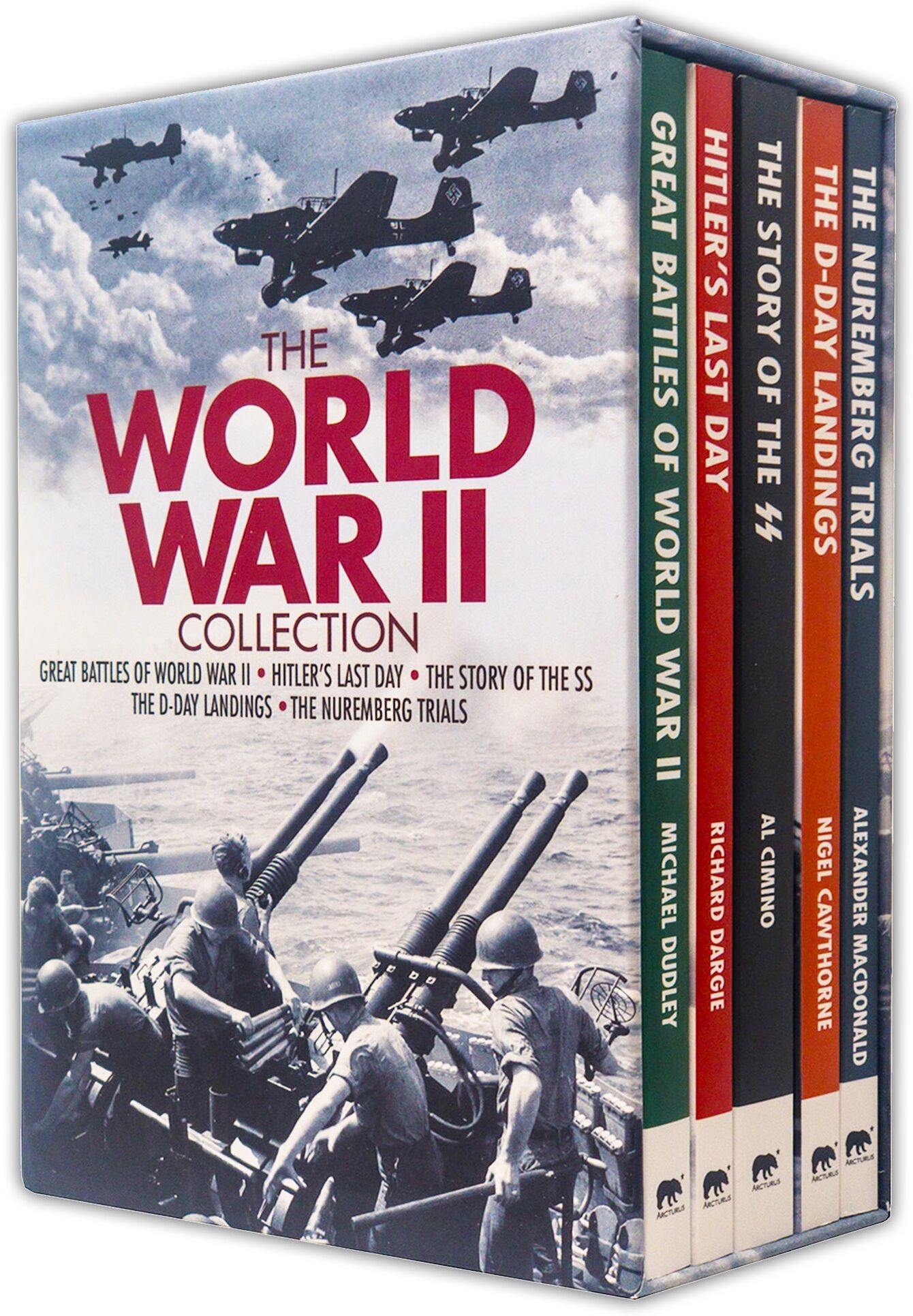
Arcturus The World War II 5 Books Collection Set – D-Day, Nuremberg Trials & Military History CollectionThis box set brings together five brilliant titles which recount the major events of World War II, from Dunkirk to the Nuremberg trials. With breakdowns of skilful military manoeuvres, chilling accounts of Nazi organisations and astounding details from the fall of Berlin, this collection chronicles the defeat of Germany and the Axis powers. These titles are: • Great Battles of World War II by Michael Dudley • The D-Day Landings by Nigel Cawthorne • Hitler's Last Day by Richard Dargie • The Story of the SS by Al Cimino • The Nuremberg Trials by Alexander Macdonald A great read for both military history enthusiasts and those eager to learn more about World War II.14,95 £*Shipping: 2,99 £Secure redirect to the provider
-
Perfect Picks Market Retro Military Watch Unisex Luxury Sport Watch With Movement vintage RedLooking for the perfect blend of style, functionality, and timeless design The THORN Retro Military Watch is here to elevate your wrist game. Designed for both men and women, this luxury sport watch boasts a 36mm case with the precision of the NH35A...269,97 $*Shipping: 0,00 $Secure redirect to the provider
-
What is the rocket principle and the principle of recoil?
The rocket principle states that for every action, there is an equal and opposite reaction. This means that when a rocket expels gas out of its engines, the force of the gas pushing out is matched by an equal force pushing the rocket in the opposite direction. The principle of recoil is similar, stating that when a gun is fired, the force of the bullet being expelled from the barrel is matched by an equal force pushing the gun in the opposite direction. Both principles are based on Newton's third law of motion, which describes the relationship between the forces acting on two interacting objects. **
-
Does the principle of solidarity correspond to the principle of equivalence?
The principle of solidarity and the principle of equivalence are related but not the same. The principle of solidarity emphasizes mutual support and collective responsibility within a community, while the principle of equivalence focuses on equal treatment and fairness. Solidarity often involves individuals or groups providing assistance or resources to those in need, even if they have not contributed equally, whereas equivalence typically requires treating individuals or groups in the same way based on certain criteria. Both principles aim to promote fairness and justice, but they operate in slightly different ways. **
-
What are the principle of operation and the principle of object?
The principle of operation refers to the fundamental method or process by which something functions or operates. It outlines the underlying rules or guidelines that govern how a system or device works. On the other hand, the principle of object pertains to the main focus or purpose of a particular entity or concept. It defines the central idea or goal that the object is designed to achieve or represent. Both principles are essential in understanding the functionality and significance of a system or object. **
-
What is the principle of maximization or the principle of minimization?
The principle of maximization or minimization is a decision-making principle that involves choosing the best option from a set of alternatives in order to maximize benefits or minimize costs. In economics, this principle is often applied to the behavior of individuals, firms, or governments when making choices about resource allocation, production, consumption, or investment. The principle of maximization suggests that decision-makers seek to maximize their utility, profits, or other desirable outcomes, while the principle of minimization suggests that decision-makers seek to minimize their costs, risks, or other undesirable outcomes. These principles are fundamental to understanding how economic agents make rational choices in pursuit of their goals. **
* All prices are inclusive of VAT and, if applicable, plus shipping costs. The offer information is based on the details provided by the respective shop and is updated through automated processes. Real-time updates do not occur, so deviations can occur in individual cases. ** Note: Parts of this content were created by AI.